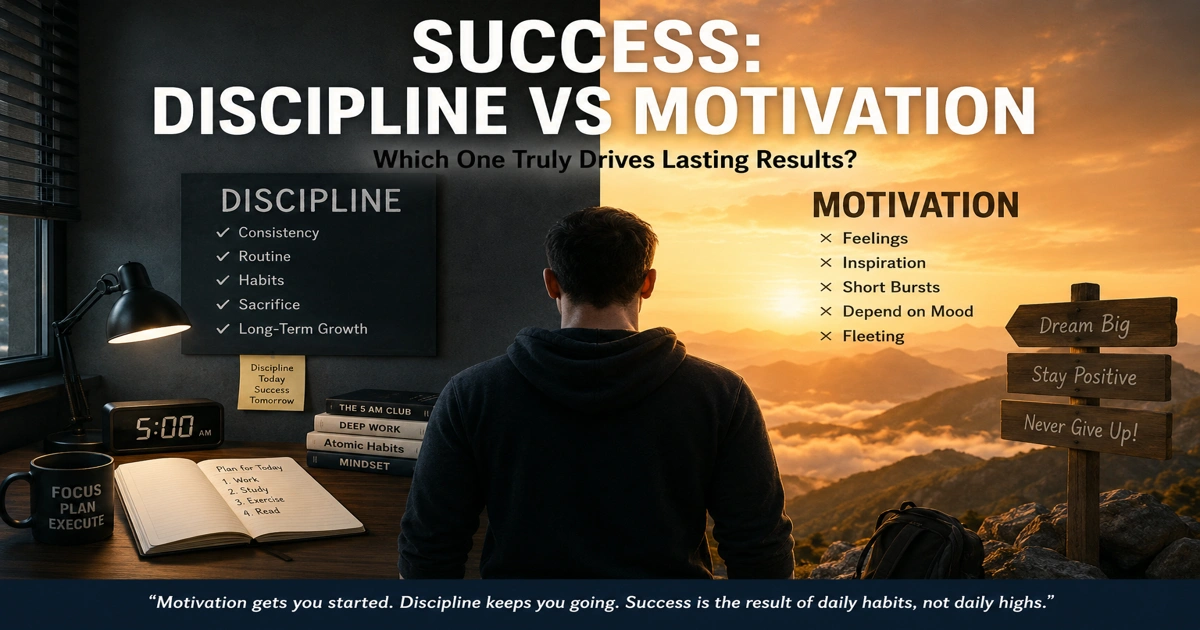
Success: Discipline vs Motivation 2026 —
What Actually Keeps You Going
Success: Discipline vs Motivation 2026
There’s a moment a lot of people know well. You set a goal — lose weight, launch a business, write a book, get up earlier — and for the first few days you’re unstoppable. You feel it. That fire. That this time is different energy. And then, somewhere around day eight or eleven or twenty-three, the feeling just… stops showing up. And so do you.
That’s not a personal failing. That’s motivation doing what motivation always does. It spikes, it fades, and it moves on to the next exciting idea. The question that matters isn’t how to get motivated — it’s what you do when the motivation is gone. That’s where discipline enters the picture. And understanding the difference between the two might be the most practically useful thing you read this year.
Motivation Is a Feeling. Discipline Is a Decision.
The easiest way to understand this distinction is to stop treating motivation like a personality trait. It isn’t. Motivation is an emotional state — closer in nature to excitement or hunger than to character. It rises under the right conditions (a new goal, a compelling story, a good night’s sleep) and drops when those conditions change. It’s responsive, not reliable.
Discipline, on the other hand, doesn’t care how you feel. It’s the part of you that goes to the gym even when it’s cold outside and you slept badly and you’d rather do literally anything else. It’s built from repetition, from small promises kept to yourself, and from a refusal to let your mood govern your behavior.
“We are what we repeatedly do. Excellence, then, is not an act, but a habit.”— Will Durant, summarizing Aristotle’s Nicomachean Ethics
Aristotle didn’t say excellence comes from wanting it badly enough. He said it comes from what you keep doing. That distinction is nearly 2,400 years old and still not widely practiced.
Why Motivation Gets All the Credit (and Discipline Gets Ignored)
Part of the problem is how success stories are told. When someone loses 80 pounds or builds a company from scratch, we hear about the turning point — the TED talk that changed everything, the personal crisis that lit the fire. The narrative skips over the 547 mornings they showed up when it wasn’t dramatic at all. Motivation makes for a better story. Discipline makes for a better life.
There’s also a structural bias in how social media works. Content that triggers emotional spikes gets shared. The motivational speech clip. The transformation photo. The overnight success myth. But the Tuesday at 6 a.m., when someone just quietly did the work — that doesn’t go viral. So we’re systematically overexposed to motivation and underexposed to the evidence of discipline in action.
The Data Behind Discipline and Motivation
This isn’t just anecdote and philosophy. Behavioral psychology and habit research have produced some fairly consistent findings about how humans actually sustain behavior over time. Here’s a snapshot of what the studies say:
| Finding | Stat / Data Point | Source |
|---|---|---|
| Average days to form a habit | 66 days (range: 18–254 days) | Lally et al., European Journal of Social Psychology (2010) |
| Daily behavior driven by habits | ~40% of daily actions are habitual, not conscious choices | Duke University / Neal et al. (2006) |
| Self-control vs. desire in success | Higher self-control linked to greater life satisfaction and goal attainment | Tangney, Baumeister & Boone, Journal of Personality (2004) |
| Willpower depletion (ego depletion) | Decision fatigue measurably reduces self-regulation after extended effort | Baumeister et al., Journal of Personality and Social Psychology (1998) |
| Goal abandonment timeline | Approximately 80% of New Year’s resolutions fail by mid-February | U.S. News & World Report / Strava data analysis (annual) |
| Routine vs. motivation in high performers | Elite athletes report structured routines as more important than emotional drive | Gould, Eklund & Jackson, Sport Psychologist (1993) |
| Consistency effect | Missing one day of a habit does not significantly reduce long-term formation | Lally et al. (2010) |
Table 1: Key research findings on habit formation, self-discipline, and motivation. Sources listed in References section.
The 66-day finding from Lally’s team at University College London is particularly worth sitting with. People often assume breaking a habit for one day resets the clock — it doesn’t. And the formation period is longer than the popular “21 days” myth suggests. Discipline, in other words, is a longer investment than most people think going in.

Key stats on discipline, habits, and long-term success. See table above for full source citations.
Success: Discipline vs Motivation 2026: What Discipline Actually Looks Like in Practice
Discipline is frequently misunderstood as something that requires suffering. That image of the 4 a.m. cold shower, the joyless grind, the person who never allows themselves to rest. That’s not discipline. That’s performance for an audience.
The Role of Systems Over Goals
James Clear, in Atomic Habits, makes a point that cuts to the heart of this: “You do not rise to the level of your goals. You fall to the level of your systems.” Goals are what motivation sets. Systems are what discipline maintains. A person who wants to run a marathon but has no running system will do nothing on the days they feel tired — which is most days after the first two weeks. A person with a system runs four times a week, marathon or not, because the system doesn’t require a goal to justify itself.
This also explains why disciplined people often appear to have extraordinary willpower when in reality they’ve structured their environment to minimize the moments when willpower is even tested.
Motivation Has a Place — Just Not the One We’ve Given It
None of this means motivation is useless. It serves a very specific function well: it gets you started. It provides the initial energy to take the first step, make the first call, write the first paragraph. Think of it as the match that lights the fire. The problem comes when people expect the match to keep burning. That’s not what matches do.
The healthy relationship with motivation is to use it when it shows up — capitalize on the energized periods — but not to wait for it. Schedule the work. Build the habit loop. Let motivation be a bonus, not a prerequisite.
The practical takeaway: Use motivation to begin. Use discipline to continue. Design systems that make discipline easier. Stop waiting to feel ready — readiness is usually a side effect of action, not a condition for it.
Success: Discipline vs Motivation 2026: The Neuroscience Behind Habit and Self-Control
There’s a brain-level reason why discipline gets easier over time. When behaviors are repeated consistently, the brain shifts them from the prefrontal cortex — the deliberate, effortful thinking region — into the basal ganglia, where automatic behaviors live. This is the neurological definition of a habit: a behavior that no longer requires conscious decision-making.
In other words, the discomfort of discipline is front-loaded. The first month of going to the gym is genuinely hard — not because you’re weak, but because your brain is still treating it as a deliberate choice that requires effort. After the habit is encoded, the same behavior requires far less mental energy. The discipline that once felt like pushing a boulder uphill starts to feel like inertia — something you’d have to make an effort to stop.
Willpower as a Finite Resource
Roy Baumeister’s ego depletion research established that self-control draws from a limited pool of cognitive resources that can be temporarily exhausted. This is why late-night snacking spikes after a difficult workday, and why you’re more likely to skip the gym when you’ve already spent eight hours making high-stakes decisions. The implications are practical: protect your discipline by making important decisions earlier in the day, reducing the number of choices you face in high-temptation moments, and building habits that automate the behavior before the depletion window.
Discipline vs. Motivation: A Side-by-Side Comparison
| Factor | Motivation | Discipline |
|---|---|---|
| Nature | Emotional state / feeling | Practiced behavior / system |
| Consistency | Variable — rises and falls | Stable once habit is formed |
| Best use | Starting new goals | Sustaining long-term progress |
| Failure mode | Disappears under stress or comfort | Can lead to rigidity or burnout without rest |
| Relationship with mood | Entirely mood-dependent | Functions independently of mood |
| Builds over time? | Not reliably | Yes — compounds through habit formation |
| Required for success? | Helpful but not essential | Essential for sustained outcomes |
Table 2: Comparing discipline and motivation across key behavioral dimensions.
Success: Discipline vs Motivation 2026: Why Discipline Alone Isn’t Enough Either
Balance matters. Discipline without rest becomes a different kind of problem — one where people confuse constant productivity with progress, and burn out well before reaching the goal they were chasing so relentlessly. Real sustainable discipline includes scheduled recovery. Rest isn’t the opposite of discipline; it’s a component of it.
Similarly, discipline without direction can produce a person who is excellent at showing up for the wrong things. Working consistently hard in a career you hate isn’t a success story. The clarity about what you’re working toward still requires honest self-reflection — something motivation, for all its faults, often initiates.
The person who succeeds over the long run usually has both: a strong enough sense of purpose to get started (motivation) and a reliable enough system to keep going (discipline). The mistake is assuming these two things serve the same function. They don’t. Honor both for what they actually are.
Success: Discipline vs Motivation 2026: People Also Ask (FAQ’s)
Is discipline more important than motivation for success?
Generally, yes — especially over the long term. Motivation provides the initial energy to start, but discipline sustains behavior when that energy fades. Research consistently shows that self-regulation and consistent routine are stronger predictors of achievement than motivational states, which are inherently temporary.
Can you build discipline without motivation?
Yes. Discipline doesn’t require motivation to function — that’s its key advantage. You build it through small, repeated actions, starting with behaviors so easy they’re difficult to avoid. Gradually raising the difficulty creates a habit loop that operates independently of how you feel on a given day.
Why does motivation disappear so quickly?
Motivation is tied to novelty, emotion, and anticipated reward — all of which diminish as a goal becomes familiar. The initial dopamine spike from setting a new goal fades as the brain recalibrates to the new baseline. This is neurologically normal, not a character flaw.
How long does it take to build self-discipline?
There’s no single answer, but habit formation research suggests an average of 66 days for a new behavior to become automatic — considerably longer than the popular “21 days” claim. The range in studies runs from 18 to 254 days depending on the person and the behavior’s complexity.
What is the role of motivation in achieving goals?
Motivation plays an important role as a trigger and initiator. It’s most useful when channeling it into building the first steps of a system — creating the structure, making the commitment public, scheduling the first actions. Once those systems are in place, motivation becomes less necessary.
Do successful people rely on motivation or discipline?
Studies of high performers — from elite athletes to entrepreneurs — consistently show that structured routine and self-regulation are the dominant factors, not emotional inspiration. Many openly acknowledge that they don’t “feel” like doing the work on most days, and do it anyway.
Authoritative References
- Lally, P., van Jaarsveld, C. H. M., Potts, H. W. W., & Wardle, J. (2010). How are habits formed: Modelling habit formation in the real world. European Journal of Social Psychology, 40(6), 998–1009. doi.org/10.1002/ejsp.674
- Neal, D. T., Wood, W., & Quinn, J. M. (2006). Habits — A repeat performance. Current Directions in Psychological Science, 15(4), 198–202. doi.org/10.1111/j.1467-8721.2006.00435.x
- Tangney, J. P., Baumeister, R. F., & Boone, A. L. (2004). High self-control predicts good adjustment, less pathology, better grades, and interpersonal success. Journal of Personality, 72(2), 271–324. doi.org/10.1111/j.0022-3506.2004.00263.x
- Gould, D., Eklund, R. C., & Jackson, S. A. (1993). Coping strategies used by U.S. Olympic wrestlers. Research Quarterly for Exercise and Sport, 64(1), 83–93.
- Duhigg, C. (2012). The Power of Habit: Why We Do What We Do in Life and Business. Random House.
- Strava. (2023). Year in Sport Data Report. strava.com/athlete/year-in-sport