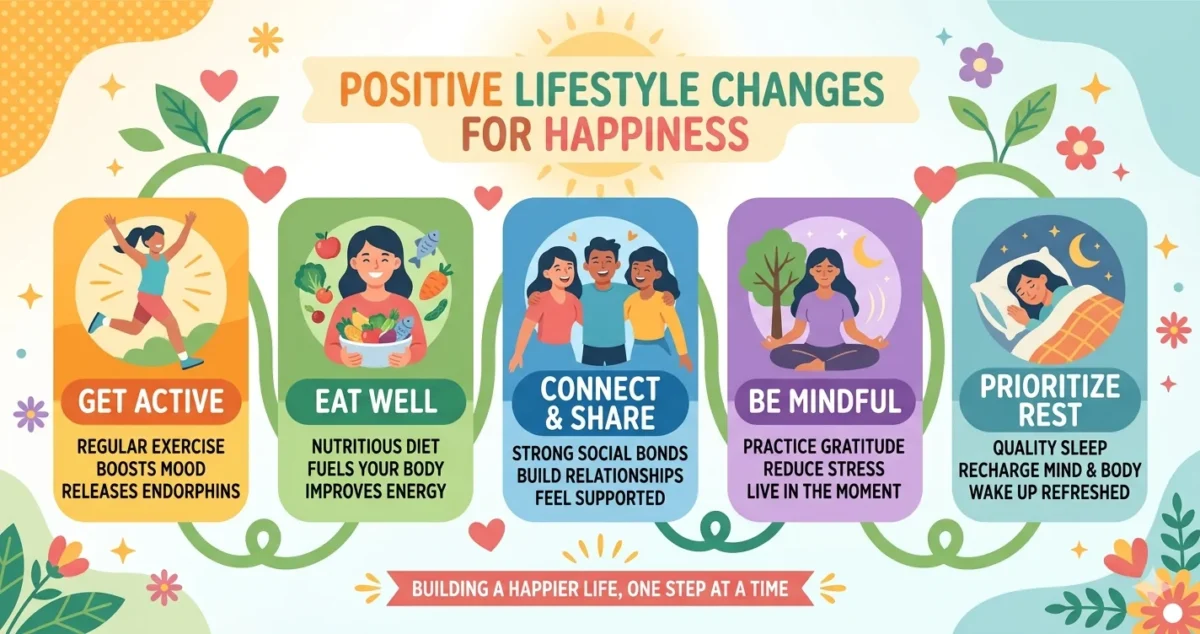
Positive Lifestyle Changes for Happiness: What Actually Works (And Why)
Discover science-backed positive lifestyle changes for happiness — from sleep and movement to connection and purpose. Real habits, real data, and honest advice you can start today.
There’s a version of “happiness advice” that feels like it was written by someone who has never had a hard week. Get up at 5 AM. Journal. Meditate. Eat your greens. Be grateful. And while none of that is wrong, exactly, it tends to gloss over the messier truth: changing how you feel takes more than a morning routine and a gratitude list.
What actually shifts the baseline — the quiet, underlying mood that colours every day — is usually slower, less dramatic, and more personal. It’s the kind of thing you don’t notice until six months have passed and you realise you’ve been laughing more. This piece is about those changes. Not the hacks. The real ones.
Why Happiness Isn’t Just a Feeling — It’s a Pattern
Psychologists have moved well past the idea that happiness is purely situational. The hedonic treadmill — the tendency to return to a set emotional baseline regardless of good or bad events — is well-documented. A landmark study by Brickman, Coates, and Janoff-Bulman (1978) found that lottery winners and accident survivors reported similar long-term happiness levels, suggesting that circumstances alone change very little.
What does move the needle is intentional activity: the deliberate choices you make every day. Sonja Lyubomirsky’s framework, widely cited in positive psychology literature, suggests that roughly 40% of happiness variation is within our control through these activities, while genetics account for about 50% and circumstances only 10%.
That 40% is worth paying attention to.

The Most Impactful Positive Lifestyle Changes (Backed by Research)
Sleep: The Underrated Foundation
Ask most people what they’d change to feel better and they’ll mention diet or exercise before sleep. But the research consistently puts sleep near the top.
A 2021 study published in Nature Human Behaviour found that improving sleep quality had a larger positive effect on well-being than getting a pay raise. The NHS recommends 7–9 hours for most adults, yet surveys suggest roughly one in three adults in the UK regularly sleeps fewer than six.
The practical shift here isn’t complicated: consistent sleep and wake times, even on weekends, stabilise your circadian rhythm more effectively than any supplement. Dim your screens an hour before bed — not because it’s trendy, but because the blue light genuinely suppresses melatonin production (Harvard Medical School, 2020).
Movement — Not Exercise Culture, Just Movement
The fitness industry has done a strange disservice to the idea of physical activity by attaching it to aesthetics and performance. But the mental health benefits of movement have nothing to do with gym memberships or body composition.
A meta-analysis published in JAMA Psychiatry (2019) found that regular physical activity reduced the odds of depression by 17%. Another analysis of 1.2 million people (The Lancet Psychiatry, 2018) found those who exercised had 1.5 fewer poor mental health days per month compared to those who didn’t.
You don’t need a plan. A 20-minute walk most days is not underachieving — it’s one of the most evidence-supported things you can do for your mood.
| Activity Type | Avg. Mental Health Benefit | Frequency Sweet Spot |
|---|---|---|
| Walking (brisk) | Moderate–High | 5x/week, 20–30 min |
| Team sports | High (social + physical) | 2–3x/week |
| Swimming | High | 3x/week |
| Yoga / stretching | Moderate | Daily or 4x/week |
| Strength training | Moderate–High | 2–3x/week |
Sources: The Lancet Psychiatry (2018); Harvard Health Publishing
The Quiet Power of Social Connection
Human beings are deeply social animals. Loneliness isn’t just unpleasant — it’s physiologically damaging. A meta-analysis by Holt-Lunstad et al. (2015) found that social isolation increases mortality risk by 26%, comparable to smoking 15 cigarettes a day.
The shift here doesn’t require becoming more extroverted. It requires being more intentional. That might mean texting a friend you’ve been meaning to call, joining a local club, or simply having one real conversation instead of ten surface-level ones.
Quality consistently outperforms quantity in the research. The Harvard Study of Adult Development — an 85-year longitudinal study, one of the longest in history — concluded that close relationships, more than money or fame, are what keep people happy throughout their lives (Waldinger & Schulz, 2023).
Reducing the Noise: Digital Boundaries
There’s a growing body of evidence linking heavy social media use to lower well-being, particularly in younger adults. A 2018 study published in the Journal of Social and Clinical Psychology found that limiting social media use to 30 minutes per day led to significant reductions in loneliness and depression over three weeks.
This doesn’t require deleting apps. It requires noticing the difference between social media that leaves you feeling connected versus the scroll that leaves you feeling vaguely hollow — and making small adjustments based on that honest self-assessment.
Purpose and Meaning: The Long Game
Viktor Frankl wrote, from the ruins of a Nazi concentration camp, that those who survived longest were often those who had something to live for. His work in logotherapy, now with substantial empirical support, points to a simple truth: a sense of meaning and purpose is one of the most durable contributors to well-being.
The 2023 Global Happiness Report found that sense of purpose was among the top three predictors of long-term life satisfaction across cultures, alongside relationships and physical health.
Purpose doesn’t have to be grand. For many people it looks like volunteering, mentoring, creative work, or simply raising children with intention. What matters is the sense that your actions connect to something beyond immediate reward.
Positive Lifestyle Changes for Happiness: Habits That Compound Over Time
Gratitude — Done Right
Gratitude journaling has been overexposed and under-explained. The version that works isn’t vague (“I’m grateful for my family”) — it’s specific and novel.
The specificity is what creates the neural reward. “I’m grateful my daughter laughed at my terrible joke over dinner” hits differently than “I’m grateful for my health.”
Spending on Experiences, Not Things
One of the most replicated findings in happiness research: experiential purchases produce more lasting well-being than material ones (Van Boven & Gilovich, 2003). Experiences become part of your identity, improve with memory, and connect more naturally to other people through shared stories.
A holiday, a concert, a cooking class — these things keep giving in a way that a new phone does not.
Volunteering and Acts of Kindness
A 2008 study in Science found that spending money on others produced greater happiness than spending the same amount on oneself, even when participants predicted the opposite. Volunteering has been linked to reduced depression, lower mortality, and higher self-esteem in multiple longitudinal studies.
Helping others, it turns out, is not selfless at all — it’s one of the more reliable things you can do for your own mental state.
A Realistic Picture: Stats That Put Things in Perspective
| Factor | Impact on Happiness |
|---|---|
| Genetic baseline | ~50% |
| Intentional activities & habits | ~40% |
| Life circumstances (income, location) | ~10% |
| Sleep deprivation (chronic) | −7% mood score |
| Regular exercise (20+ min, 3x/week) | +1.5 better mental health days/month |
| Close social relationships | Among top 3 life predictors |
| Sense of purpose | Among top 3 life predictors |
Sources: Lyubomirsky (2008); The Lancet Psychiatry (2018); Global Happiness Report (2023)
Positive Lifestyle Changes for Happiness: People Also Ask
Q: Can lifestyle changes actually make you happier long-term?
Yes — but the effect is gradual. Research consistently shows that intentional habits around sleep, movement, relationships, and meaning shift the emotional baseline over months, not days.
Q: How long does it take to feel the effects of lifestyle changes?
Most studies show measurable improvements in mood and well-being within 4–12 weeks of consistent habit change. Sleep improvements tend to show effects faster (days to weeks), while social and purpose-related changes take longer but are more durable.
Q: What is the single most impactful lifestyle change for happiness?
The research doesn’t give a single answer, but sleep quality and social connection appear most consistently across different studies and populations.
Q: Does money affect happiness?
Up to a point. A 2021 study by Matthew Killingsworth found well-being rises with income well beyond the original $75,000 threshold — but the relationship flattens significantly at higher income levels. Relationships and purpose consistently outperform income in longitudinal data.
Q: Is happiness a choice?
Partly. You can’t choose your genetic baseline or many of your circumstances, but the research is clear that deliberate habits and mindset shifts influence roughly 40% of your emotional experience.
Authoritative References
- Brickman, P., Coates, D., & Janoff-Bulman, R. (1978). Lottery winners and accident victims: Is happiness relative? Journal of Personality and Social Psychology, 36(8), 917–927.
- Lyubomirsky, S. (2008). The How of Happiness. Penguin Press.
- Holt-Lunstad, J., et al. (2015). Loneliness and social isolation as risk factors for mortality. Perspectives on Psychological Science, 10(2), 227–237.
- Dunn, E. W., Aknin, L. B., & Norton, M. I. (2008). Spending money on others promotes happiness. Science, 319(5870), 1687–1688.
- Van Boven, L., & Gilovich, T. (2003). To do or to have? That is the question. Journal of Personality and Social Psychology, 85(6), 1193–1202.
- Killingsworth, M. A. (2021). Experienced well-being rises with income. PNAS, 118(4).
- NHS (2024). How much sleep do we need? — nhs.uk/sleep